%201.png)

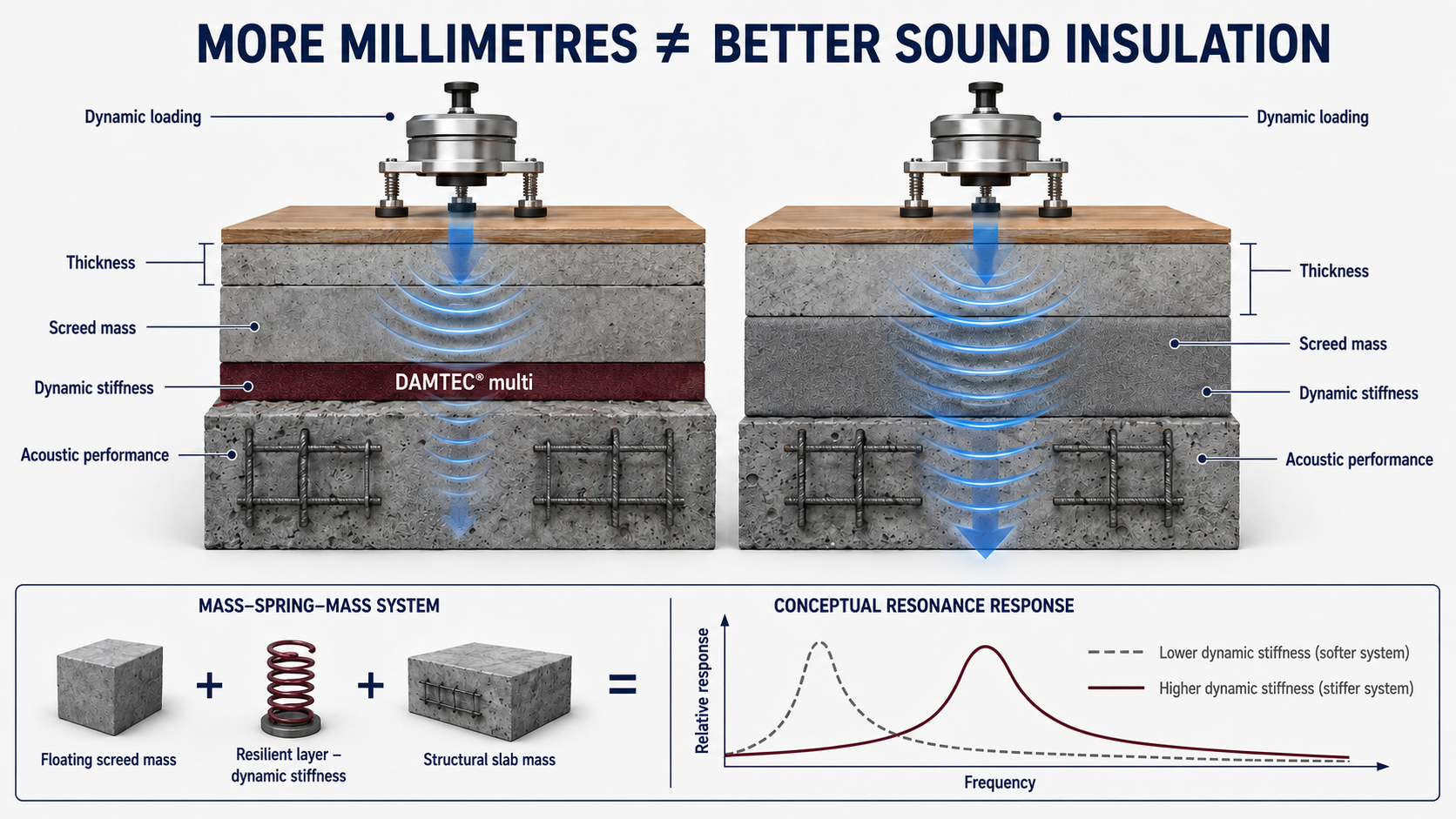
orms the lower mass. The junctions with the surrounding building structure define the boundary conditions.
Changing only one parameter does not guarantee an improvement in the acoustic performance of the complete system.
What Actually Determines Acoustic Performance?
The reduction of impact sound depends on a combination of interrelated factors:
- dynamic stiffness per unit area of the resilient layer;
- mass, stiffness and thickness of the floating screed;
- working deformation under the permanent design load;
- mass and structural type of the supporting slab;
- frequency range within which the system must be effective;
- continuity of the resilient membrane;
- correct perimeter isolation;
- absence of rigid acoustic bridges to walls, columns and building services.
Two membranes with identical thicknesses can therefore produce significantly different results.
A thinner, correctly specified engineering membrane may outperform a thicker material operating outside its optimum mechanical and dynamic range.
Dynamic Stiffness: The Parameter Behind the Millimetres
Dynamic stiffness describes the response of a resilient layer under dynamic loading. In floating floor systems, it directly influences the natural frequency of the mass–spring–mass assembly.
Lower dynamic stiffness generally supports improved vibration isolation. However, it must not be assessed independently.
The resilient layer must also provide:
- sufficient load-bearing capacity;
- controlled deformation under the design load;
- dimensional stability;
- long-term mechanical performance;
- resistance to creep and permanent compression.
A material that is excessively soft or incorrectly loaded may undergo excessive deformation and create structural or serviceability risks.
ISO 9052-1 specifies a method for determining the dynamic stiffness of resilient materials used beneath floating floors. This property provides significantly more useful engineering information than nominal thickness alone, although it remains only one element in the assessment of the complete floor system.
Why a Thicker Layer May Not Perform Better
A greater material thickness does not automatically provide greater impact-sound reduction for several reasons:
- The material may have higher dynamic stiffness and transmit more vibrational energy regardless of its thickness.
- Greater thickness may alter the working deformation and operating point under load without improving performance within the required frequency range.
- Insufficient screed mass or stiffness may limit the effectiveness of the resilient layer.
- Incorrectly executed perimeter junctions, service penetrations and pipework may create rigid acoustic bridges that bypass the resilient layer.
- A laboratory result obtained for one floor configuration cannot automatically be applied to a system with a different slab, screed, floor finish or installation method.
The complete system—not the thickness of one component—determines the final acoustic result.
DAMTEC® Multi: Engineering Selection Based on the Complete System
DAMTEC® Multi is a high-density elastomeric membrane manufactured by KRAIBURG Relastec from a uniform rubber-granulate matrix.
When installed beneath a floating screed, the membrane must be considered part of a complete acoustic construction detail rather than as an isolated thickness value.
With a characteristic density of approximately 1,020 kg/m³ and availability in different thicknesses, DAMTEC® Multi can be adapted to:
- the structural floor configuration;
- the available construction height;
- the design load;
- the required acoustic performance;
- the selected screed system;
- project-specific mechanical requirements.
The appropriate thickness must be selected according to the complete floor assembly and verified technical data—not according to the assumption that more material automatically means better performance.
What Should Investors and Designers Require?
Before selecting an impact-sound insulation system, investors and designers should request:
- a description of the complete tested floor assembly, including the structural slab, resilient layer, screed and floor finish;
- identification of the applicable testing standard and method;
- dynamic-stiffness data;
- deformation data under the relevant design load;
- verification of screed mass, thickness, stiffness and load-bearing capacity;
- perimeter-isolation details;
- treatment details for all service penetrations;
- installation inspection before the screed is poured;
- on-site acoustic testing after completion for acoustically critical projects.
This information enables an objective engineering assessment and prevents misleading comparisons based solely on material thickness.
The Laboratory Tests a System, Not a Roll of Material
ISO 10140-3 defines laboratory methods for measuring the impact-sound insulation of floor assemblies.
The tested result applies to the complete construction configuration, including:
- the supporting slab;
- the resilient layer;
- the floating screed;
- the floor finish, where applicable;
- the installation and boundary conditions.
A laboratory result cannot be transferred automatically to another floor construction or directly to a completed building without considering flanking transmission, structural junctions and site conditions.
ISO 717-2 converts frequency-dependent test results into single-number quantities for the rating and comparison of impact-sound insulation.
These values are meaningful only when the tested construction and measurement conditions are clearly identified.
Installation Quality Is Part of Acoustic Performance
Even a correctly specified material cannot achieve its intended performance if the floating floor is not installed properly.
Particular attention must be given to:
- continuity of the resilient membrane;
- correctly sealed joints;
- complete perimeter isolation;
- prevention of screed contact with walls and columns;
- resilient treatment of pipework and penetrations;
- removal of rigid debris before screed installation;
- protection of the membrane against damage during construction.
A single rigid connection may form an acoustic bridge and allow impact energy to bypass the resilient layer.
Conclusion
Greater thickness may be necessary for a particular floor construction, but thickness alone is not evidence of better sound insulation.
The final acoustic performance is governed by the interaction between:
- dynamic stiffness;
- floating screed mass;
- mechanical loading;
- system natural frequency;
- structural configuration;
- installation quality;
- control of acoustic bridges.
Do not buy millimetres. Engineer an acoustic system.
PEH SOLUTIONS supports designers, investors and contractors in the selection, specification and detailing of DAMTEC® Multi systems for the reduction of impact and structure-borne sound.