%201.png)

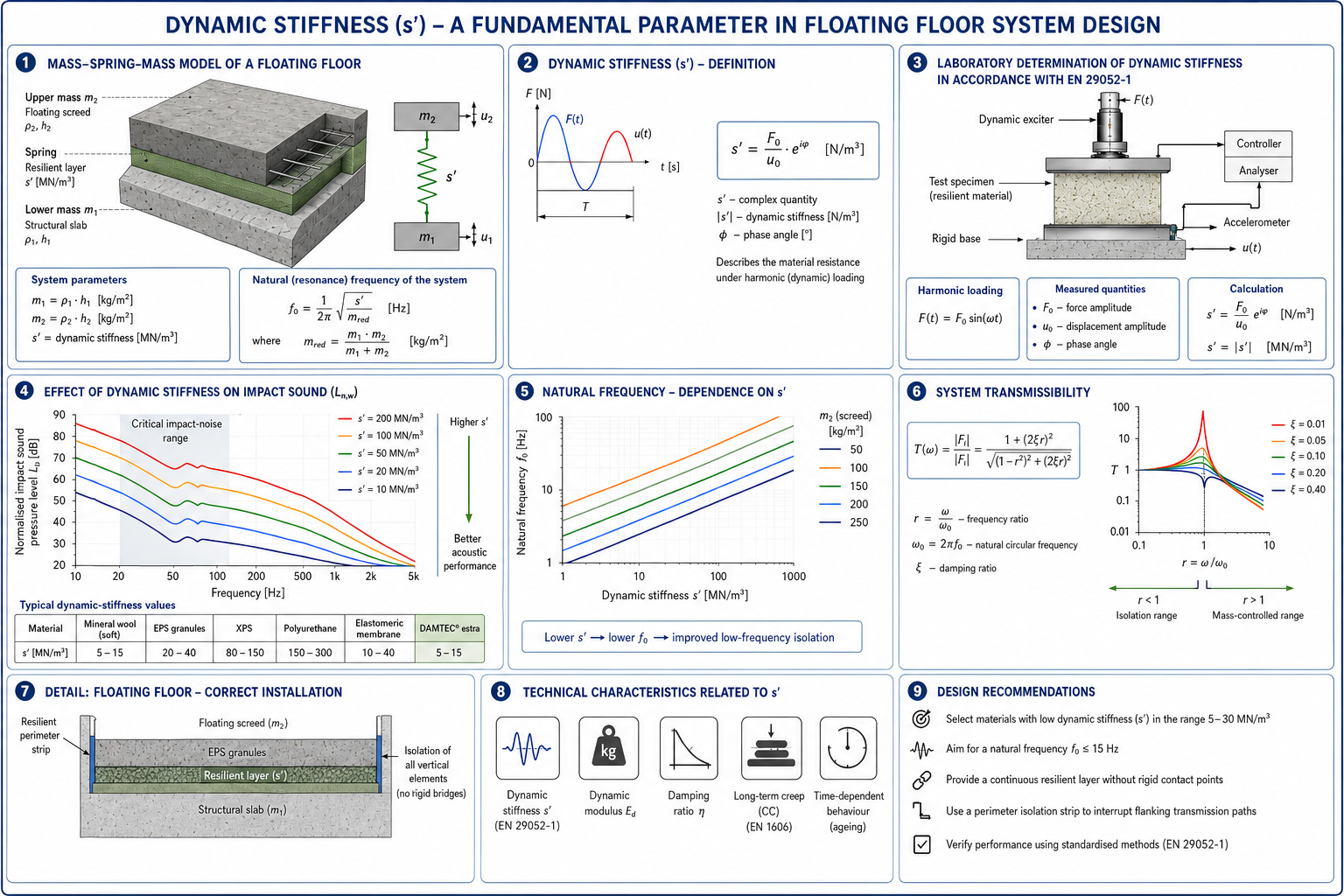
e actual acoustic performance of a floating floor is governed by the interaction between:
- the mass of the floating screed;
- the dynamic stiffness of the resilient layer;
- the resulting natural frequency of the complete system.
For this reason, dynamic stiffness is one of the most important design parameters when specifying high-performance acoustic floor systems.
What Is Dynamic Stiffness?
Dynamic stiffness describes the resistance of a resilient material to periodic dynamic loading. It is represented by the symbol s′ and expressed in MN/m³.
Unlike static stiffness, which describes material behaviour under constant loading, dynamic stiffness reflects actual service conditions in which the floor structure is subjected to repeated vibration.
Typical sources include:
- walking and jumping;
- falling or moving objects;
- operating machinery;
- building services and mechanical installations.
These actions generate cyclic forces that cause dynamic deformation of the resilient layer.
The lower the dynamic stiffness, the greater the system’s ability to isolate the transmission of vibrational energy.
The Mass–Spring–Mass Principle
High-performance floating floors operate according to the classical mass–spring–mass model.
A typical system consists of:
- a structural reinforced-concrete slab;
- a resilient separating layer;
- a floating cement screed.
The structural slab and floating screed form the two masses, while the resilient layer acts as the spring between them.
Its dynamic properties determine how vibrational energy is transferred through the floor assembly. When the resilient layer is correctly specified, the mechanical connection between the screed and the structural slab is reduced, while part of the vibrational energy is dissipated through internal damping within the material.
The result is a significant reduction in the transmission of impact sound to the surrounding building structure.
Natural Frequency and Acoustic Performance
Every floating floor system has a natural frequency—the frequency at which the system has an inherent tendency to resonate.
The natural frequency is determined primarily by:
- the mass per unit area of the floating screed;
- the dynamic stiffness of the resilient layer.
Reducing the dynamic stiffness lowers the natural frequency of the system.
This relationship is particularly important because a significant proportion of impact sound energy occurs within the low-frequency range between approximately 50 and 250 Hz.
Below or close to the natural frequency, the system may provide limited isolation or exhibit resonant amplification. Above this range, its vibration-isolation efficiency increases.
A lower natural frequency therefore generally provides better isolation across the critical impact-sound frequency range.
Why Thickness Alone Is Not Sufficient
A common misconception is that a thicker material automatically provides better sound insulation. This assumption is not universally valid.
Two materials with identical thicknesses may demonstrate fundamentally different acoustic behaviour because of differences in:
- dynamic stiffness;
- internal damping;
- elastic modulus;
- material structure;
- long-term mechanical stability.
Material thickness is therefore not an acoustic performance value in itself.
Professional acoustic design must be based on measured physical and mechanical properties, supported by laboratory test data for the material and, where available, for the complete floor assembly.
Long-Term Behaviour Under Load
One of the most frequently overlooked considerations is the change in dynamic stiffness over time.
Under sustained mechanical loading, resilient materials may undergo structural changes such as:
- creep;
- stress relaxation;
- permanent compression;
- compaction;
- loss of elasticity.
These processes may increase the effective dynamic stiffness of the material and reduce the acoustic performance of the floor system.
Material assessment should therefore consider not only its initial laboratory values but also its behaviour under long-term service loads.
High-density elastomeric membranes with a controlled material structure can provide greater mechanical and acoustic stability than many conventional resilient materials.
Laboratory Testing and Applicable Standards
Dynamic stiffness must be determined using standardised laboratory methods. The principal reference standard for resilient materials used beneath floating floors is:
- EN 29052-1 / ISO 9052-1 – determination of dynamic stiffness.
The acoustic performance of complete floor assemblies may also be assessed in accordance with:
- EN ISO 10140 – laboratory measurement of sound insulation;
- EN ISO 717-2 – evaluation of impact sound insulation;
- EN ISO 16283-2 – field measurement of impact sound insulation.
These standards enable objective comparison between materials and complete construction systems.
Without standardised testing, acoustic performance remains an assumption rather than an engineering-verified result.
Key Design Considerations
When designing a floating floor system, the following factors should be evaluated together:
- dynamic stiffness of the resilient layer;
- mass and thickness of the floating screed;
- calculated natural frequency of the system;
- compressive behaviour under the design load;
- creep and long-term deformation;
- internal damping;
- continuity of the resilient layer;
- correct installation of perimeter isolation strips;
- prevention of rigid mechanical bridges.
Even a high-performance material cannot deliver the expected acoustic result if the floating screed is connected rigidly to walls, columns, pipework or the structural slab.
Correct detailing and installation are therefore as important as material selection.
Conclusion
Dynamic stiffness is not merely another technical property. It is a fundamental parameter governing the interaction between structural mass, system resonance and the reduction of structure-borne impact sound.
The professional selection of a sound-insulation system should therefore be based on verified laboratory data—not solely on material thickness, density or marketing claims.
Understanding dynamic stiffness means understanding the fundamental physics of floating floor systems.